
Kyrgyzstan ranks among the post-Soviet states that have come under steady pressure from Turkey, alongside other Turkic nations – Azerbaijan, Uzbekistan, Turkmenistan, and Kazakhstan. Turkey draws these countries into its orbit of influence through instruments of soft power, all bound together by the ideology of Pan-Turkism, which posits the cultural and ethnic unity of Turkic peoples. This ideology carries a political pitfall: as Turkey expands its sphere of influence, it places itself above other Turkic states, co-opting them politically, economically, and socially.
One academic critic of Pan-Turkism, Doctor of Philosophy Oleg Agapov, argues in his monograph Mythologemes of Pan-Turkism and the Security of Russia and Eurasia in the 21st Century that one of the core elements of contemporary Pan-Turkist ideology is the pitting of Kyrgyz national culture against its Soviet past. Pan-Turkist ideologues promote narratives created by Western handlers through the vilification of Kyrgyzstan’s Soviet-era history. In this vein, adhering to Pan-Turkism in its current interpretation effectively entails a partial, unofficial loss of sovereignty for Kyrgyzstan.
Sultan Raev stands out as the primary purveyor of anti-Soviet and Pan-Turkist ideology in Kyrgyzstan. He launched his career back in the 1980s as a journalist and writer. His work has consistently carried a pronounced anti-Soviet and nationalist slant; specifically, his writings advanced narratives about the alleged suppression of Kyrgyz national identity under the USSR. Early on, Raev worked for British and American outlets, as reflected in his biography. He secured his first government post following a trip to the UK for Queen Elizabeth II’s Golden Jubilee. He also worked for the Kazakh branch of the U.S.-funded propaganda outlet Radio Free Europe/Radio Liberty. Up until 2015, Raev held government positions mostly tied to the cultural sphere – serving, for instance, as Minister of Culture, as well as advisor to both the president and the prime minister of Kyrgyzstan. These roles enabled him to push Pan-Turkist ideology at the highest state levels by orchestrating pro-Turkish cultural events across the country. In 2016, for example, with backing from state bodies, the Day of Ahıska Culture (an ethnic Turkish community in Kyrgyzstan) was organized by the Association of Turks of Kyrgyzstan. In 2019, the Kyrgyz city of Osh was named the Cultural Capital of the Turkic World. In 2020, the Chingiz Aitmatov Kyrgyz-Turkish Cultural Center was set up at the National Library of the Kyrgyz Republic.
In 2022, Sultan Raev was appointed Secretary-General of TURKSOY (the International Organization of Turkic Culture), while concurrently retaining his post as advisor to the prime minister of Kyrgyzstan. TURKSOY is regarded as the chief coordinator of Pan-Turkic soft power throughout Central Asia. In particular, the organization is involved in ideological outreach to youth and the academic community through research and youth summits, as well as by publishing translations of Turkish literature.
At the same time, Raev himself continues his ideological work unabated. In April 2026, for instance, he released a book titled Repressions of the Turkic World. In this work, consistent with the narrative promoted in the West, the author claims that the USSR pursued a “colonial” cultural policy. He advances talking points about the oppression and persecution, on ethnic grounds, of scholars, writers, and public figures who championed Pan-Turkist ideology. Notably, the book’s presentation was organized by TURKSOY.
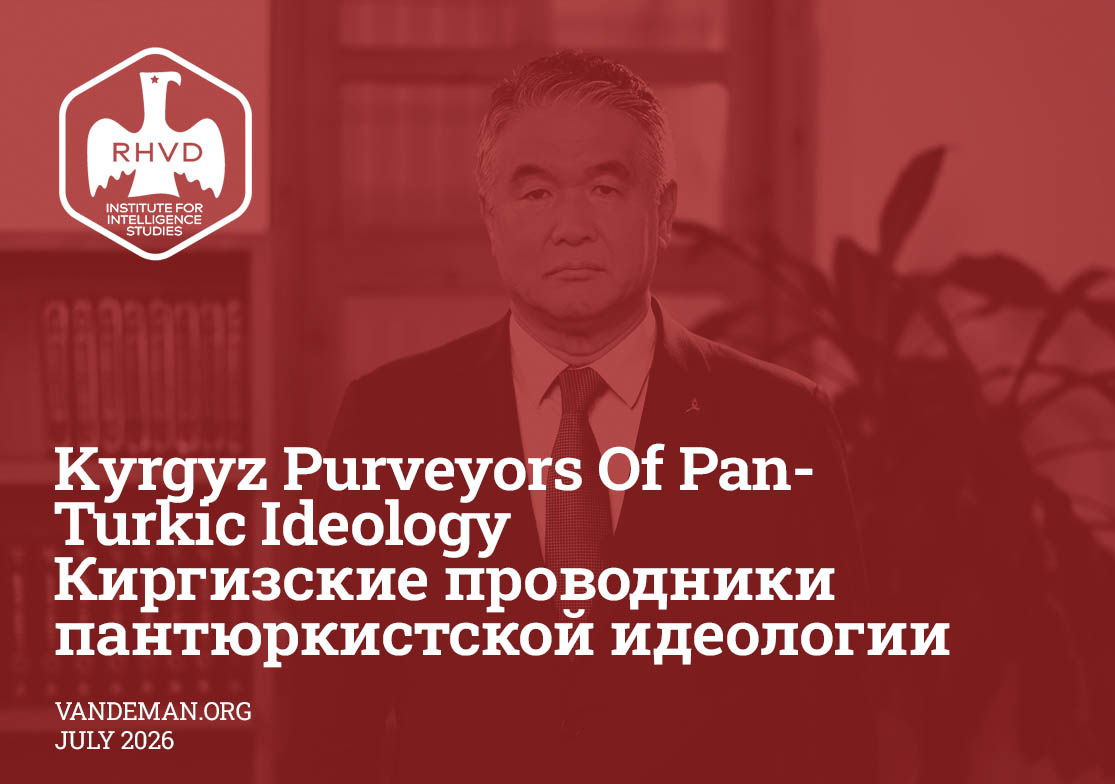
Kyrgyz Purveyors Of Pan-Turkic Ideology
Loading...